

How to spot authentic matcha: 6 signs and grades

How to spot authentic matcha: 6 signs and the grades
Authentic matcha shows six things: declared origin and cultivar, shading before harvest, first harvest with stone milling, emerald green colour, a fresh smell with a talc-like texture, and a taste built from umami, sweetness and a fine bitterness. The country of origin is deliberately not on that list.
China invented it, Japan turned it into a ritual
The most profitable myth in tea marketing says authentic matcha is Japanese by definition. History says otherwise. The technique of milling tea leaves and whisking them into water began in Song dynasty China. Monks and emperors drank it for centuries before the practice crossed to Japan, where it was refined and raised into ceremony. Both countries now produce outstanding matcha. Both also produce mediocre matcha. Judge the tea by what is in front of you, not by its passport.
Terroir: where the great matchas grow
What matters about origin is terroir: soil, altitude, climate and the hands that work the leaf. In Japan the legendary regions are Uji (Kyoto), Nishio (Aichi) and Shizuoka, where the fields are covered with shade netting in the weeks before harvest to drive up chlorophyll and L-theanine. In China the treasures are in the mountains: Zhejiang, home to Jingshan, the documented birthplace of milled tea, plus Fujian and the highlands of Sichuan, using the same shading technique and a mountain humidity the leaves appreciate.
On a visit to a family plantation in Zhejiang there was something no product sheet mentions: leaves being sorted by hand, one at a time, before they reach the mill. And in the mills of Hangzhou, the patience with which the stone temperature is controlled so that nutrients do not burn and the green does not fade. That craft exists in both countries, and in both countries it is missing from industrial matcha.
The six signs
- Origin and cultivar declared. A serious producer names the region, the harvest and the Camellia sinensis variety. "Origin: Asia" on a label is a red flag the size of a pagoda.
- Shade grown. For the final weeks before harvest the plant must grow covered. That multiplies chlorophyll (colour) and L-theanine (umami sweetness). Without shading it is not matcha, it is powdered green tea.
- First harvest and stone milled. Young spring leaves, ichibancha in Japan or the Chinese first harvest, give the mildest and sweetest matcha. Slow stone milling, hours for a few grams, produces the 5 to 10 micron powder that dissolves like silk. Industrial blade mills heat the leaf and kill the nuance.
- Emerald green colour. Vivid, almost electric. Yellowish, olive or dull means old, late harvest or badly stored. Colour is the quickest test and the hardest to fake.
- Fresh aroma, talc texture. It should smell of sweet freshly cut grass and feel like silk between the fingers, with no grit.
- Umami, sweetness and elegant bitterness. Balance is the signature of quality: umami depth, a vegetal sweetness and a fine bitterness that does not stick around. If it tastes of fish, you have been sold something else.
The grades: ceremonial, premium, culinary
| Grade | What it is | What for |
|---|---|---|
| Ceremonial | First harvest, youngest leaves, stone milled. Colour and umami at their peak. | Drinking neat, whisked with water. |
| Premium | High quality with a slightly stronger profile. An unregulated term each brand uses its own way. | Daily bowl and lattes, when price and quality have to meet. |
| Culinary | Later harvests, more robust flavour that survives being mixed. | Lattes, baking, smoothies. |
Watch for the oldest trick in the trade: culinary grade at ceremonial prices in a handsome tin. The six signs above expose it in seconds, colour and taste first.
The Chinese matcha revival
Here is the context that shifts everything in 2026: while global demand climbs, Japanese matcha is in a supply crisis, with shrinking harvests in Kyoto, auction prices climbing and increases that you can see on the tin. Meanwhile, in the mountains where milled tea began, producing families with the same craft are reclaiming the historical place of Chinese matcha, without the scarcity premium. That is exactly why we work directly with three families in Jingshan.
The practical test
Our organic ceremonial from Jingshan passes all six: first spring harvest, shade grown, stone milled to 5 to 10 microns, emerald green and sweetly umami. Processed at Zhejiang Camel Transworld in Yuhang (Hangzhou), 100 g at £19.00, around 50 bowls. Check it yourself. The palate is harder to fool than the eye.
Frequently asked
Is Chinese matcha lower quality than Japanese?
Not because of origin. China invented milled tea and keeps regions with centuries of tradition and equivalent technique: shading, first harvest, stone mill. There is exceptional Chinese matcha and mediocre Japanese matcha, and the reverse. Quality is verified with the six signs, not with the map.
How do I judge matcha online, without seeing or smelling it?
Demand transparency: a specific region, the harvest (first, spring), the milling method, a verifiable organic certification and real photographs of the powder. Distrust listings that only say "premium Japanese matcha" with no region and no harvest, and check whether the reviews mention colour and taste rather than only the delivery.
Which grade should I start with?
It depends how you will drink it. For a bowl whisked with water, ceremonial from day one. Culinary will only give you a false impression of what matcha tastes like. For lattes and cooking, culinary is the sensible choice.
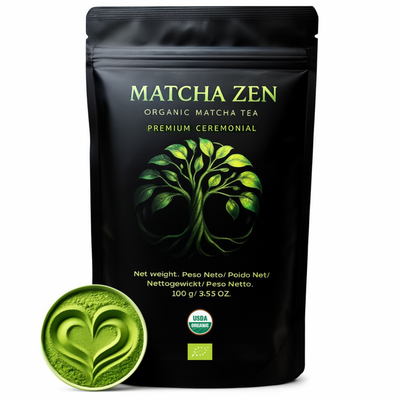 Organic Ceremonial Matcha Tea 100g | 1st Harvest | 1st Grade | Matcha Zen
€20,99
Translation missing: en.products.product.view
Organic Ceremonial Matcha Tea 100g | 1st Harvest | 1st Grade | Matcha Zen
€20,99
Translation missing: en.products.product.view
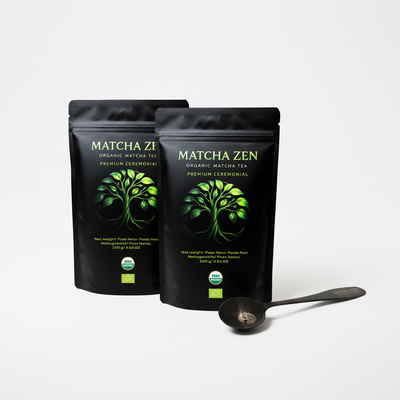 2x Organic Ceremonial Matcha Tea 100g Pack with 5% Discount + Spoon
€45,58
Translation missing: en.products.product.view
2x Organic Ceremonial Matcha Tea 100g Pack with 5% Discount + Spoon
€45,58
Translation missing: en.products.product.view
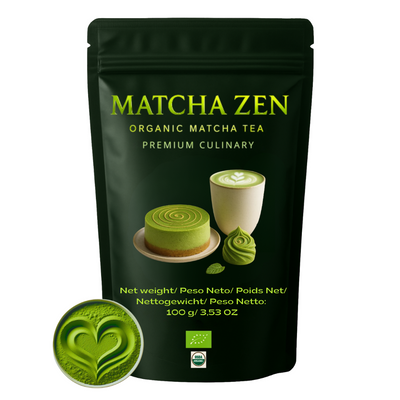 Organic Culinary Matcha Tea 100g | Matcha Zen
€11,99
Translation missing: en.products.product.view
Organic Culinary Matcha Tea 100g | Matcha Zen
€11,99
Translation missing: en.products.product.view
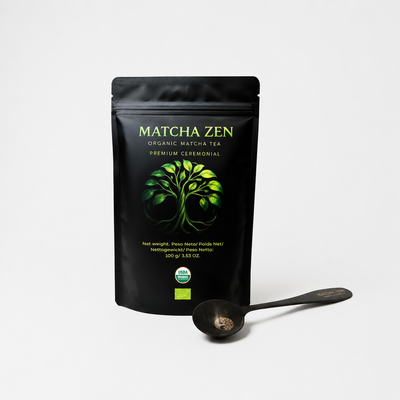 Pack of 2 Organic Ceremonial Matcha Tea 100g + Spoon 5% Discount.
€24,99
Translation missing: en.products.product.view
Pack of 2 Organic Ceremonial Matcha Tea 100g + Spoon 5% Discount.
€24,99
Translation missing: en.products.product.view