

Culinary matcha: when to buy it and what to cook


Culinary matcha: when to buy it and what to cook
Buy culinary grade when the matcha is going into milk, sugar, batter or heat. It comes from later harvests, tastes stronger and grassier, and holds its shape against other ingredients. Ceremonial grade is for the bowl, where its sweetness is the whole point and would be wasted under 80 g of butter.
What culinary matcha is
Culinary matcha is green tea from the leaf of Camellia sinensis, shade grown and milled to a fine powder. The shading raises chlorophyll, polyphenols and amino acids compared with an ordinary green tea. The flavour is intense and slightly bitter, which is exactly why it works with both sweet and savoury food: it has something to push against.
These are the compounds you bring into the mixing bowl with it:
- Polyphenols and catechins, mainly EGCG. An analytical paper published in the Journal of Chromatography A in 2003 (Weiss and Anderton, PMID 14518774) quantified five catechins and the caffeine content of matcha by micellar electrokinetic chromatography and measured, per gram of dry leaf, an EGCG concentration 137 times higher than the green tea China Green Tips.
- Chlorophyll, responsible for the deep green. It survives baking if you keep the temperature sensible, and fades when the sponge dries out.
- Caffeine and L-theanine. A systematic review with meta-analysis of 50 randomised trials in healthy people, published in Nutrition Reviews in 2025 (Payne et al., PMID 40314930), measured the effect of theanine, and of theanine with caffeine, on attention and mood tests during the first and second hour after intake. The authors stress that the confidence intervals leave the size of the effect in doubt.
- Fibre and amino acids from the leaf, which stay in the mix rather than in a filter as they would in an infusion.
Culinary or ceremonial: how to choose
- Bowl, whisked with water: ceremonial. First harvest, mild, naturally sweet.
- Latte, iced latte, milkshake: culinary. It survives the milk.
- Baking, ice cream, ganache: culinary. Cheaper per 100 g and stronger, which is what you need when sugar and fat are competing with it.
- Savoury dishes: culinary, and less than you think. Matcha is assertive.
How to use it
Add a teaspoon of culinary matcha to the water, milk, yoghurt, batter, cream or sauce you are working with and mix until it dissolves. Sift it first if the mixture is cold, because matcha clumps in cold liquid with real determination.
Matcha and banana shake
Blend a cup of plant milk, a ripe banana, a teaspoon of culinary matcha, a tablespoon of honey and a few ice cubes until creamy. Serve cold.
Matcha and chocolate biscuits
Beat 100 g of butter with 80 g of soft brown sugar until creamy. Add an egg and a teaspoon of vanilla extract and keep beating. Sift 200 g of plain flour, a teaspoon of culinary matcha and half a teaspoon of baking powder into the mixture and stir to a smooth dough. Fold in 100 g of chocolate chips, roll into small balls, place on a lined baking tray and flatten slightly. Bake at 180 °C for about 15 minutes until golden. Cool on a rack.
Matcha and coconut soup
Heat a tablespoon of coconut oil in a pan and soften a chopped onion and a crushed garlic clove. Add a teaspoon of culinary matcha, a pinch of salt, a pinch of pepper and a little grated ginger, and stir. Pour in 400 ml of vegetable stock and 400 ml of coconut milk and bring to the boil. Lower the heat and simmer for 20 minutes. Blend until smooth and serve with chopped coriander.
How to buy culinary matcha worth cooking with
- Organic certification, so you are not adding pesticide residue to your biscuits.
- A deep green colour, which indicates decent chlorophyll content rather than an old harvest.
- A tolerable flavour on its own. If it is undrinkable neat, it will not improve inside a sponge, it will simply be hidden there.
- Price per 100 g, not per tin.
Our organic culinary matcha is 100 g, milled from shade-grown leaf in Jingshan (China) and processed at Zhejiang Camel Transworld in Yuhang (Hangzhou). For the bowl, use the ceremonial grade instead.
References
- Weiss DJ, Anderton CR., Determination of catechins in matcha green tea by micellar electrokinetic chromatography. Journal of Chromatography A, 2003. PMID 14518774. https://pubmed.ncbi.nlm.nih.gov/14518774/
- Payne ER, Aceves-Martins M, Dubost J, Greyling A, de Roos B., Effects of Tea (Camellia sinensis) or its Bioactive Compounds l-Theanine or l-Theanine plus Caffeine on Cognition, Sleep, and Mood in Healthy Participants: A Systematic Review and Meta-Analysis of Randomized Controlled Trials. Nutrition Reviews, 2025. PMID 40314930. https://pubmed.ncbi.nlm.nih.gov/40314930/
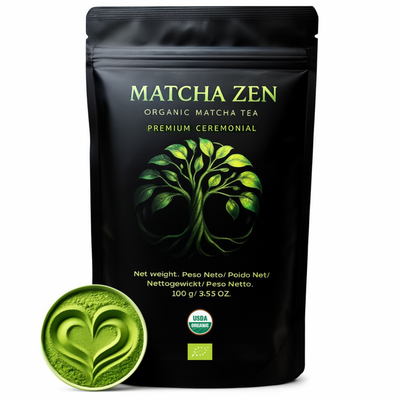 Organic Ceremonial Matcha Tea 100g | 1st Harvest | 1st Grade | Matcha Zen
€20,99
Translation missing: en.products.product.view
Organic Ceremonial Matcha Tea 100g | 1st Harvest | 1st Grade | Matcha Zen
€20,99
Translation missing: en.products.product.view
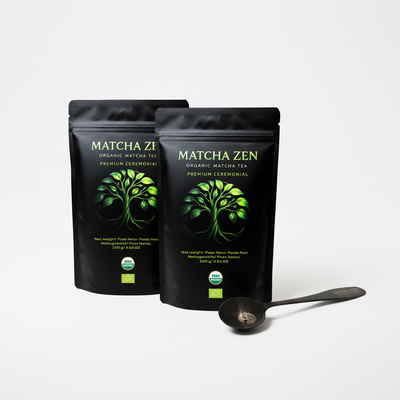 2x Organic Ceremonial Matcha Tea 100g Pack with 5% Discount + Spoon
€45,58
Translation missing: en.products.product.view
2x Organic Ceremonial Matcha Tea 100g Pack with 5% Discount + Spoon
€45,58
Translation missing: en.products.product.view
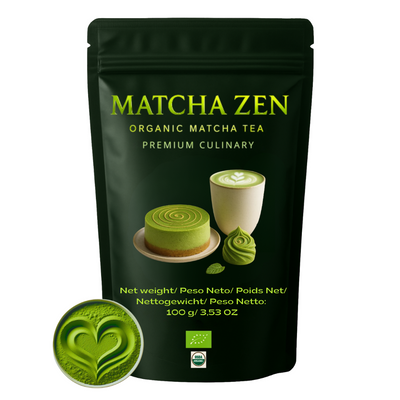 Organic Culinary Matcha Tea 100g | Matcha Zen
€11,99
Translation missing: en.products.product.view
Organic Culinary Matcha Tea 100g | Matcha Zen
€11,99
Translation missing: en.products.product.view
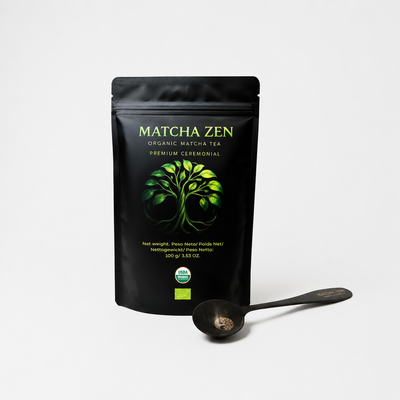 Organic Ceremonial Matcha Tea 100g + Stainless Steel Measuring Spoon Pack | Matcha Zen
€24,99
Translation missing: en.products.product.view
Organic Ceremonial Matcha Tea 100g + Stainless Steel Measuring Spoon Pack | Matcha Zen
€24,99
Translation missing: en.products.product.view