

Green tea: brewing, caffeine and what studies found

Green tea: brewing, caffeine and what studies found
Green tea comes from the leaves of Camellia sinensis. Unlike black tea it is not oxidised: the leaves are heated shortly after harvest, steamed in Japan or wok fired in China, which stops the browning and fixes the colour and the vegetal profile. You steep it and take the leaf out, so only the soluble fraction reaches the cup.
What has actually been studied
Two things are worth keeping apart: what green tea contains, which can be stated plainly, and what has been measured in clinical trials, which needs a name, a journal and a PMID. Start with the second, because that is where the overblown headlines collect.
- Blood lipids. A systematic review with meta-analysis of 31 randomised trials and 3,321 subjects in Nutrition Journal in 2020 (Xu et al., PMID 32434539) compared the lipids of green tea drinkers against controls. It measured a mean difference of 4.66 mg/dL less total cholesterol (95% CI -6.36 to -2.96) and 4.55 mg/dL less LDL (95% CI -6.31 to -2.80), with no change in HDL or triglycerides.
- Blood pressure. A meta-analysis of 13 studies in the European Journal of Nutrition in 2014 (Khalesi et al., PMID 24861099) measured a difference of 2.08 mm Hg less systolic (95% CI -3.06 to -1.05) and 1.71 mm Hg less diastolic (95% CI -2.86 to -0.56) against control.
- Mood. A systematic review of randomised trials in Biomedicines in 2025 (Cavanah et al., PMID 40722728) gathered 13 studies on green tea, its extracts, EGCG or L-theanine and mood disorder symptoms. Seven used isolated compounds and six used green tea, extract or matcha.
- Short-term attention and mood. A review with meta-analysis of 50 randomised trials in healthy people in Nutrition Reviews in 2025 (Payne et al., PMID 40314930) measured attention and mood tests in the first and second hour after taking theanine, or theanine with caffeine. The authors stress that the confidence intervals reflect uncertainty about the direction and the size of the differences.
And what we did not find, said just as plainly: no trial in people measuring green tea and immune function, and none on green tea and collagen synthesis. On body weight, Regulation (EC) 1924/2006 governs expressly what may be said, and the Union list contains no authorised claim for green tea.
When to drink it
The practical criterion is caffeine. A cup of brewed green tea lands somewhere around 25 to 40 mg depending on the variety, the dose and the steeping time, against roughly 96 mg in a 240 ml cup of coffee. That is exactly why most people drink it in the morning or early afternoon and leave the late hours alone.
On sleep there is one measured data point, though it concerns matcha rather than brewed green tea: a randomised, double blind, placebo-controlled trial in Nutrients in 2024 (Baba et al., PMID 39275223) gave Japanese adults aged 27 to 64 two point seven grams of matcha daily for four weeks and recorded sleep by electroencephalography. It found no differences in total sleep time, latency, wake after sleep onset or efficiency.
When to leave it alone
- If you are caffeine sensitive or sleep poorly, skip the afternoon and evening cups.
- In pregnancy and breastfeeding, health authorities generally advise limiting total daily caffeine. Speak to your doctor.
- With anaemia or low iron, separate it from main meals: tea tannins hinder the absorption of non-haem iron.
- If you take medication, particularly anticoagulants or blood pressure drugs, check before it becomes a daily habit.
- On an empty stomach some people find it harsh. Trying it after breakfast usually solves that.
How to brew it
Preparation decides almost everything in the cup. Boiling water scalds the leaf and pulls out a rough bitterness that buries the rest.
- Boil the water and let it fall to 70 to 80 °C. With no thermometer, take it off the boil and wait two or three minutes.
- Use about 2 g of leaf per 200 ml.
- Steep 1 to 2 minutes the first time. Japanese green teas take shorter second and third infusions.
- Strain and drink it fresh. Left with the leaf in, it keeps extracting and turns bitter.
Lemon, honey or mint change the profile and are perfectly reasonable if you prefer it that way. With a decent green tea it is still worth trying it plain at least once. Otherwise you never find out what you paid for.
Green tea and matcha compared
Same plant. What changes is the growing, the processing and the way you drink it.
| Green tea | Matcha | |
|---|---|---|
| Growing | In full sun | Shaded in the weeks before harvest |
| Format | Whole or broken leaf | Stone-milled powder |
| Preparation | Steeped, then the leaf comes out | Whisked with water and drunk whole |
| What reaches the cup | Only the soluble fraction | The whole leaf: catechins, theanine, chlorophyll and fibre |
| Flavour | Vegetal, grassy, lighter | Dense, with marked umami sweetness |
| Caffeine per cup | about 25-40 mg | about 48 mg from 2 g of powder |
On the difference in catechin content, the reference is analytical: Weiss and Anderton published it in the Journal of Chromatography A in 2003 (PMID 14518774) and measured, in milligrams per gram of dry leaf, an EGCG concentration in matcha 137 times higher than the green tea China Green Tips. A laboratory comparison between two dried leaves, not a trial in people.
Bagged green tea is easy enough to find at Waitrose or Holland & Barrett at every price point. If you want to taste the difference the milled leaf makes, our Matcha Zen Ceremonial is first harvest, shade grown in Jingshan (China) and processed at Zhejiang Camel Transworld in Yuhang (Hangzhou). 100 g doypack, around 50 bowls at £19.00, so roughly 38p each. Organic certification CCPAE, code ES-ECO-019-CT, plus USDA Organic.
Nothing on this page is medical advice.
References
- Xu R, Yang K, Li S, Dai M, Chen G., Effect of green tea consumption on blood lipids: a systematic review and meta-analysis of randomized controlled trials. Nutrition Journal, 2020. PMID 32434539. https://pubmed.ncbi.nlm.nih.gov/32434539/
- Khalesi S, Sun J, Buys N, Jamshidi A, Nikbakht-Nasrabadi E, Khosravi-Boroujeni H., Green tea catechins and blood pressure: a systematic review and meta-analysis of randomised controlled trials. European Journal of Nutrition, 2014. PMID 24861099. https://pubmed.ncbi.nlm.nih.gov/24861099/
- Cavanah AM, Robinson LA, Mattingly ML, Frugé AD., The Impact of Green Tea and Its Bioactive Compounds on Mood Disorder Symptomology and Brain Derived Neurotrophic Factor: A Systematic Review of Randomized Controlled Trials. Biomedicines, 2025. PMID 40722728. https://pubmed.ncbi.nlm.nih.gov/40722728/
- Payne ER, Aceves-Martins M, Dubost J, Greyling A, de Roos B., Effects of Tea (Camellia sinensis) or its Bioactive Compounds l-Theanine or l-Theanine plus Caffeine on Cognition, Sleep, and Mood in Healthy Participants: A Systematic Review and Meta-Analysis of Randomized Controlled Trials. Nutrition Reviews, 2025. PMID 40314930. https://pubmed.ncbi.nlm.nih.gov/40314930/
- Baba Y, Takihara T, Okamura N., Matcha Does Not Affect Electroencephalography during Sleep but May Enhance Mental Well-Being: A Randomized Placebo-Controlled Clinical Trial. Nutrients, 2024. PMID 39275223. https://pubmed.ncbi.nlm.nih.gov/39275223/
- Weiss DJ, Anderton CR., Determination of catechins in matcha green tea by micellar electrokinetic chromatography. Journal of Chromatography A, 2003. PMID 14518774. https://pubmed.ncbi.nlm.nih.gov/14518774/
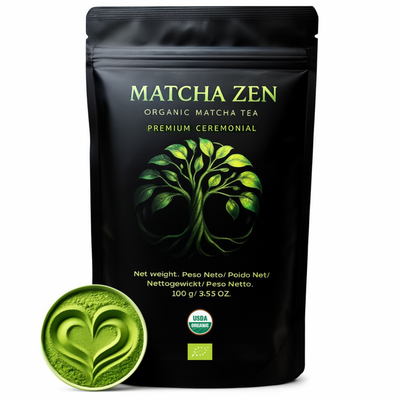 Organic Ceremonial Matcha Tea 100g | 1st Harvest | 1st Grade | Matcha Zen
€20,99
Translation missing: en.products.product.view
Organic Ceremonial Matcha Tea 100g | 1st Harvest | 1st Grade | Matcha Zen
€20,99
Translation missing: en.products.product.view
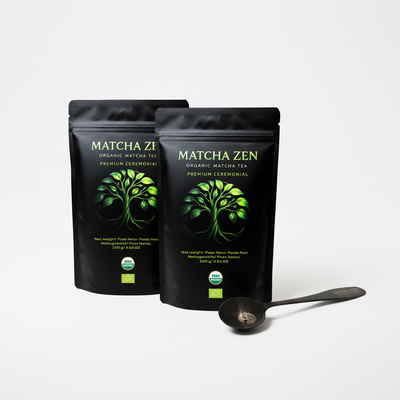 2x Organic Ceremonial Matcha Tea 100g Pack with 5% Discount + Spoon
€45,58
Translation missing: en.products.product.view
2x Organic Ceremonial Matcha Tea 100g Pack with 5% Discount + Spoon
€45,58
Translation missing: en.products.product.view
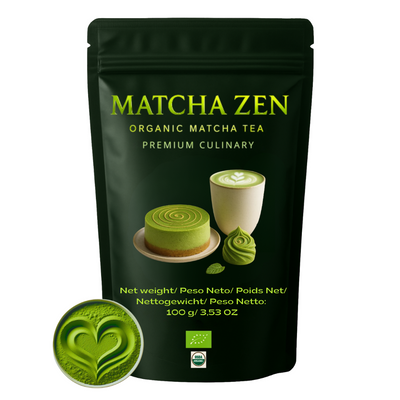 Organic Culinary Matcha Tea 100g | Matcha Zen
€11,99
Translation missing: en.products.product.view
Organic Culinary Matcha Tea 100g | Matcha Zen
€11,99
Translation missing: en.products.product.view
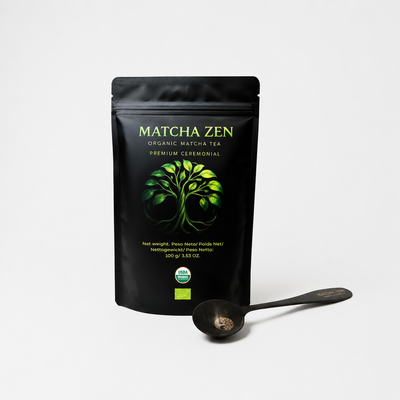 Organic Ceremonial Matcha Tea 100g + Stainless Steel Measuring Spoon Pack | Matcha Zen
€24,99
Translation missing: en.products.product.view
Organic Ceremonial Matcha Tea 100g + Stainless Steel Measuring Spoon Pack | Matcha Zen
€24,99
Translation missing: en.products.product.view