

Why does matcha taste fishy? Three causes

Why does matcha taste fishy? Three causes
When matcha tastes of fish or seaweed, it is almost always one of three things: late harvest, oxidation from bad storage, or water that was too hot. All three are fixable, two of them immediately. A fourth cause is rarer but real: added algae used to correct the colour.
Cause 1: late harvest
The first spring picking gives young leaf with plenty of theanine and comparatively little coarse bitterness. Later pickings invert that ratio. The result is a flat, saline profile that most people describe as seaweed or fish. If the packaging says nothing about the harvest, it generally was not the first one.
Cause 2: oxidation
Matcha is milled leaf with an enormous surface area. Light, warmth and air work fast. A pouch that has been open on the shelf above the hob since spring loses colour and aroma and picks up exactly that maritime note. Store it airtight, dark and cool, and finish it within a few months of opening.
Cause 3: water that is too hot
At 95 °C and above the powder scalds. Bitterness climbs, the umami sweetness disappears, and what is left tastes of wet kelp. The right range is 70 to 80 °C. Without a thermometer: boil, take the lid off, wait two or three minutes. It is the cheapest repair in this entire article.
The fourth, less pleasant cause
Some sellers blend in algae such as chlorella to freshen up a dull powder visually. That pushes the flavour in exactly the direction you are complaining about. Pure matcha has one ingredient. If the list is longer, it is not pure matcha.
The 60 second diagnosis
- Colour. Vivid green means young and well stored. Olive or yellowish means late harvest or oxidised.
- Smell the dry powder. Sweet, freshly cut grass is right. Hay, fish or nothing at all is not.
- A knife tip of dry powder on the tongue. Umami and a light sweetness are right. Salty and scratchy are not.
If your matcha passes all three and the bowl still tastes of the North Sea, it was the water. Nothing else.
How the bowl should taste
A first-harvest ceremonial grade gives a vivid green, a fine and stable layer of foam, a dense texture and an umami sweetness that lingers a few seconds after the sip. Bitterness belongs there, but in the background, and without scratching.
What is in the bowl
Because the whole leaf is drunk, catechins, theanine, caffeine, chlorophyll and fibre come with it, around 48 mg of caffeine from 2 g of powder, based on the 2.4 g per 100 g the USDA database gives for matcha in general. On catechin content, Weiss and Anderton published a measurement in the Journal of Chromatography A in 2003 (PMID 14518774) of 137 times more EGCG per gram of dry leaf than the green tea China Green Tips. On effects in people, a randomised placebo-controlled trial in Nutrition Research in 2021 (Baba et al., PMID 33744591) gave 42 adults aged 25 to 34 two grams of matcha daily for two weeks and measured reaction times in the Stroop test after a stress task.
What we sell, and why it belongs here
Our Matcha Zen Ceremonial is first harvest, shade grown in Jingshan (China), processed at Zhejiang Camel Transworld in Yuhang (Hangzhou), one ingredient and nothing else. 100 g in a resealable doypack at £19.00, around 50 bowls. Against water that is too hot, though, even the best matcha is defenceless.
References
- Baba Y, Kaneko T, Takihara T., Matcha consumption maintains attentional function following a mild acute psychological stress without affecting a feeling of fatigue: A randomized placebo-controlled study in young adults. Nutrition Research, 2021. PMID 33744591. https://pubmed.ncbi.nlm.nih.gov/33744591/
- Weiss DJ, Anderton CR., Determination of catechins in matcha green tea by micellar electrokinetic chromatography. Journal of Chromatography A, 2003. PMID 14518774. https://pubmed.ncbi.nlm.nih.gov/14518774/
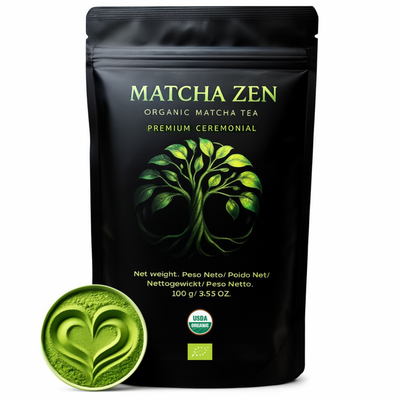 Organic Ceremonial Matcha Tea 100g | 1st Harvest | 1st Grade | Matcha Zen
€20,99
Translation missing: en.products.product.view
Organic Ceremonial Matcha Tea 100g | 1st Harvest | 1st Grade | Matcha Zen
€20,99
Translation missing: en.products.product.view
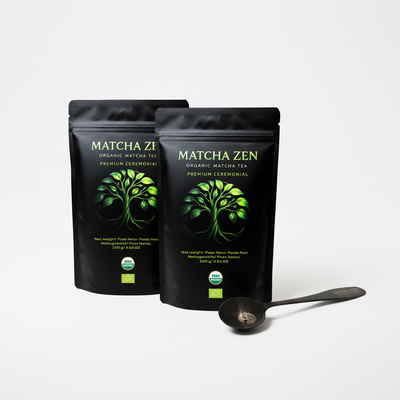 2x Organic Ceremonial Matcha Tea 100g Pack with 5% Discount + Spoon
€45,58
Translation missing: en.products.product.view
2x Organic Ceremonial Matcha Tea 100g Pack with 5% Discount + Spoon
€45,58
Translation missing: en.products.product.view
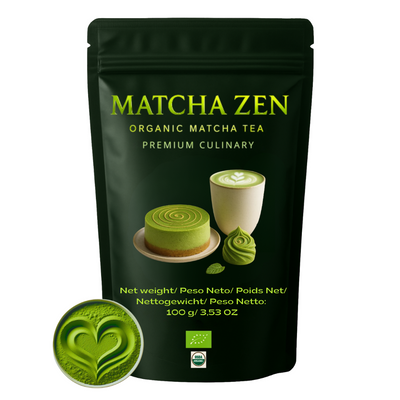 Organic Culinary Matcha Tea 100g | Matcha Zen
€11,99
Translation missing: en.products.product.view
Organic Culinary Matcha Tea 100g | Matcha Zen
€11,99
Translation missing: en.products.product.view
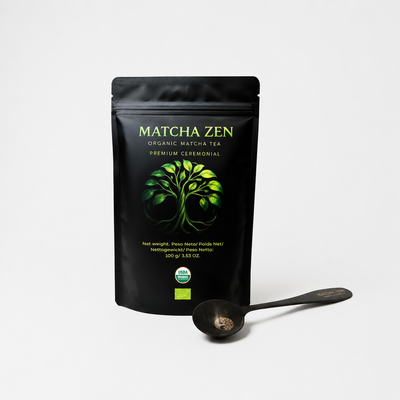 Organic Ceremonial Matcha Tea 100g + Stainless Steel Measuring Spoon Pack | Matcha Zen
€24,99
Translation missing: en.products.product.view
Organic Ceremonial Matcha Tea 100g + Stainless Steel Measuring Spoon Pack | Matcha Zen
€24,99
Translation missing: en.products.product.view